
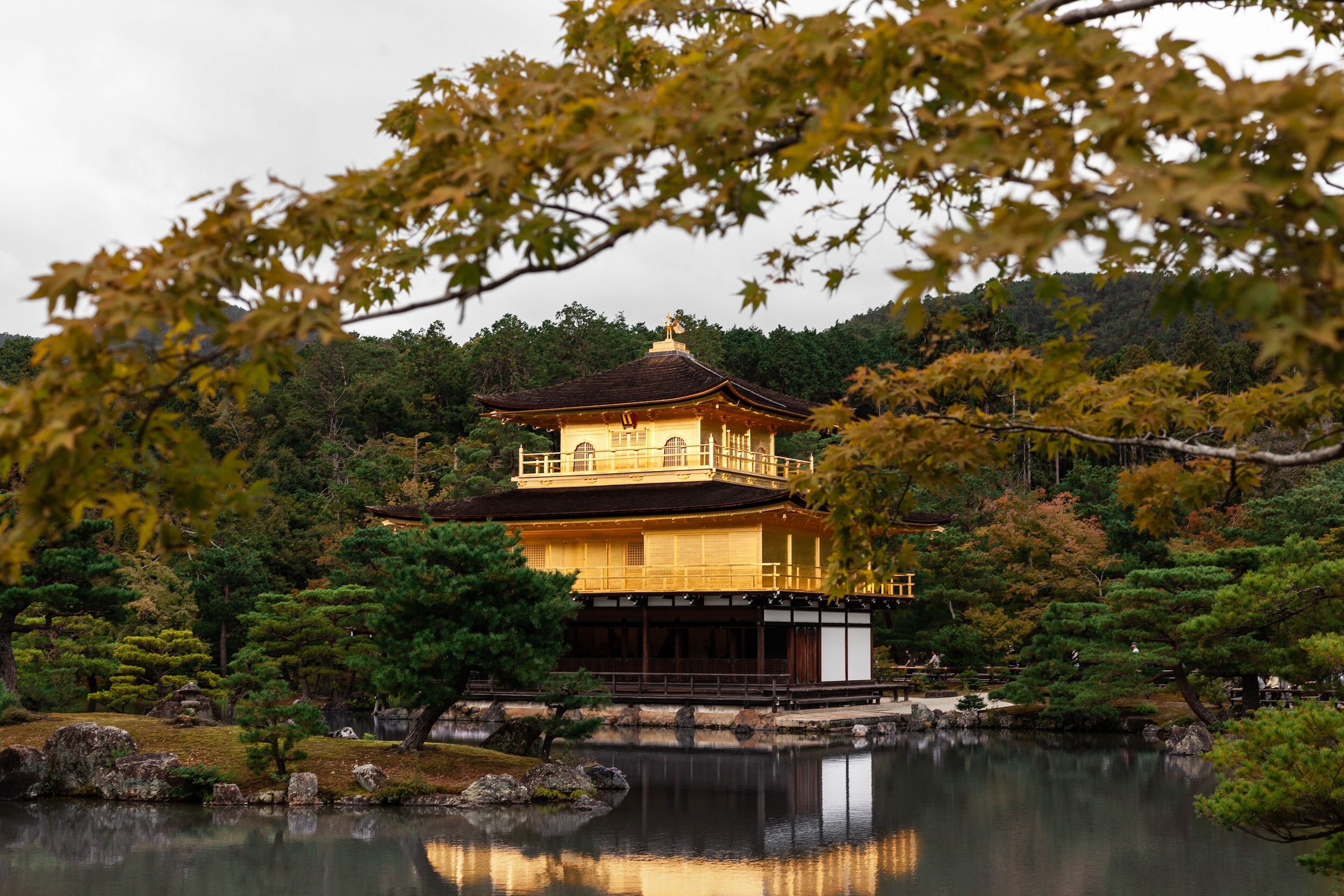
Golden Pavilion by @charlespostiaux Unsplash
In 1397 this Buddhist temple began as a private residence.
Built for the most powerful man in Japan at the time (Shogun Ashikaga Yoshimitsu). As requested in his will, when he died the pavilion was turned into a Zen Buddhist Temple. All other buildings except the Golden Pavilion in this complex burned down during the civil war of 1467.
However, centuries later, the Temple of the Golden Pavilion wasn’t as lucky.
On July 2nd, 1950 a young 22-year old monk deliberately burned down the pavilion for ‘hatred of beauty’. This event inspired Yukio Mishima’s novel The Golden Pavilion. In 1955, a new building was reconstructed to be as close to the original as possible.
The three storied pavilion is built in three different styles with gold-leaf covering the walls of the top two stories.
The ground floor, the Chamber of Dharma Waters, is built in the palace style from the 11th century. The second floor, the Tower of Sound Waves is in the style of a samurai palace. And the top floor, the Cupola of the Ultimate is designed in distinctively Zen Temple style.
The garden retains much of its 14th century style and a short walk away is Japan’s most famous Zen garden, Ryoanji, laid out in the 15th century.